- Name 82px -> 46px (was truncating 'KEEN HAWK' and dominating).
- QR now a proper right-hand verify stub: 214px band with a dashed divider and
  a 156px QR (was a small bottom-corner stub). Applied to all front types.
- Rebalanced geometry (portrait 244, text 338, stub 214); identity/badges sit on
  the lower band; back side stays plain typographic with a small right QR.
- Fixed a string of fillText(fitText(...)) calls that were missing their x.
Design: the card read like a spec sheet (16 competing elements, 5-6px type).
Rebuilt as an editorial credential:
- Left full-height portrait panel; right column = brand, ONE huge name, a single
  identity line (style / level / local), nip05, crew monograms + witnessed
  badges, and a clean QR verify stub. Dropped the tiny stats row, npub clutter,
  'Powered by Nostr' filler and the 'SKATER LICENSE' chrome.
- Same system applied to Park / Crew / Event fronts; typed-up back side.

Engine: the studio preview and /card/:npub now render the canvas PNG, so there
is a SINGLE renderer (src/lib/riderCardCanvas.ts) — no React/canvas drift. The
old React card components + CardQr are deleted. Holographic is now a canvas
sheen. Also fixed several fillText calls missing an x-coord.
- Custom accent colour (native picker) overrides the theme accent via
  --ss-accent in CSS + the canvas palette.
- Optional personal logo/crest (Blossom upload) shown next to the name.
- Printable back side (RiderCardBack React + drawCardBack canvas); Print renders
  both sides, and the preview + public card can flip.
- Park passes enforce valid-thru: passExpiry() drives an EXPIRED badge on the
  card and verify page; the input is now a date picker.
- Card schema -> v:3 (accent/logo/back). i18n; NIP.md + AGENTS.
- /card gains a fourth type: Event. Renders an event (kind 31923) you organise
  or RSVP'd going/interested to (useMyRsvpCoords, kind 31925) as a passport/
  wristband: title, date/time, venue, cover, who it admits, going count.
  Derived from the event's own signed event — its QR verifies that event;
  /verify/:naddr renders kind 31923 too. React + canvas renderers; i18n.
- /review gains a dedicated Claims tab (pending private-spot ownership claims),
  replacing the banner that sat above the tabs.
Private spots can't be domain-verified like shops, so ownership is a gated
two-step flow — never an instant takeover:
- A NIP-05-verified user files a claim (kind 1985 label in the separate
  org.skatespots.spotclaim namespace) on a spot marked access=private.
- A moderator approves by publishing claim-approved (moderation namespace,
  a=coord + p=claimant); surfaced in a pending-claims list atop /review.
- The claimant then finishes by re-publishing the spot with
  claim-reason=private-approved (existing claim mechanism).

Adds useSpotClaims/useApprovedSpotClaims/useAllSpotClaims/useSubmitSpotClaim,
useAdminApproveClaim, the private branch in SpotOwnership, i18n, and docs.
Non-private spots keep the abandoned-claim flow. Nothing is auto-transferred.
- Card shows crew crests (kind 35006 memberships), a local badge (skater
  profile location/home_spot), and Lab role chips (kinds 35001-35014) — all
  DERIVED LIVE, so a card can't claim a role/crew the skater doesn't have.
- Rendered in the React card + the canvas export (print/PNG); local/crews as
  text lines, roles as blue chips.
- Per-facet show toggles in the editor; card schema bumped to v2 so the new
  flags default ON for cards saved before them.
- Also fixed: verifyUrl wasn't passed to the canvas renderer (QR fell back to
  the profile path).
- i18n cardUi.facets.* / cardUi.roles.*; NIP.md + AGENTS.md updated.
- Publish the Rider Card as an addressable event (kind 32271, d=rider-card) and
  hydrate the editor from it, so customization persists across devices.
- New routes: /card/:npub (public read-only card) and /verify/:naddr
  (signature check + park venue binding).
- Park Access Cards can bind to the issuer's own spot (a tag 30818:...) and the
  verify page confirms the issuer owns the venue.
- QR on the card (+ canvas export) now encodes the verify URL; the real QR
  renders in the React card too (was a placeholder / broken profile path).
- Extracted shared card visuals to src/components/RiderCard.tsx; helpers in
  src/lib/riderCard.ts; hooks useRiderCard/useRiderBadges.
- Documented in NIP.md; i18n cardUi namespace (EN/ES); smoke test covers the
  new routes.
- /subscribe + /native/poll/register carry the enabled categories; the server
  stores them per subscription/token and only pushes matching ones (DM wrap ->
  dms; offer/counter/accept/attestation/shipment -> trades). Absent = legacy
  (all), empty array = none.
- /pending uses a per-category activity breakdown so it only moves for the
  token's categories; the smoke test proves a DM does NOT wake a trades-only token.
- usePushNotifications/useBackgroundDelivery send categories (from device prefs)
  and expose resubscribe(); NotificationSettingsCard re-sends on toggle change.
Server: /native/subscribe + /native/unsubscribe (NIP-98 proof), FCM device store,
and FCM HTTP v1 sending (service-account OAuth2, cached ~1h); /health reports
native + device count. 503 without PUSH_FIREBASE_SERVICE_ACCOUNT_JSON.
Client: @capacitor/push-notifications (lazily imported, native-only) in
usePushNotifications - request permission, register, store the FCM token, and
subscribe via /native/subscribe; tap deep-links into the app.
Needs a Firebase project: google-services.json + the Gradle plugin (android/),
and the service-account JSON in the host .env.
A pure swap has no invoice, so ListingTradeActions now offers a 'Good-faith
deposit' input for price_type=trade listings. Paying it stores a deposit-slot
receipt (saveReceipt(coord, r, 'deposit')); the buyer's confirm attaches it as
['proof','deposit',preimage,payment_hash] with method=trade, so a barter carries
a verifiable COST without pretending the goods were proven.
- getPaymentHashFromBolt11 (bolt11.ts, dependency-free; matches the BOLT11 spec
  test vector) + verifyPreimage (sha256(preimage) === payment_hash).
- usePayPaymentPointer captures the preimage from NWC/WebLN/melt and returns a
  PaymentReceipt; PayWithSats.onPaid carries it; stored device-locally so the
  later confirm step attaches it; publishTrade writes
  ['proof','lnpreimage',preimage,hash] (and ['proof','deposit',...] for barter).
- useTradeReputation verifies and counts it in paymentVerified.
- Honest scope: proves PAYMENT, not delivery; money legs only - a pure hardware
  swap has no invoice, stays attested; a deposit receipt gives barter real cost.
- ['shipping','buyer'|'seller'|'split'] tag + create-page selector.
- Distance from the viewer's last known location (cache only, no GPS prompt) on
  both gear cards, and a 'Nearest (local)' sort on GearSwapPage.
- HandoffHelper (buyer-only, in ListingTradeActions) opens the trade DM
  pre-filled: suggest a time & place / share delivery details / use a locker,
  with anti-scam copy. Details stay in the NIP-17 DM; the app never sees them.
- ships deals now nudge safety on all platforms, not just when escrow is ready.
pow.ts: minePow/verifyPow/countLeadingZeroBits. PoW pays NO ONE - it is a free
CPU tax, not a fee. useNostrPublish accepts pow and mines the nonce on the
UNSIGNED event before signing (id is signature-independent -> one signer prompt).
CreateListingPage sends 16 bits per listing (~80ms) and 20 bits when a newcomer
chooses work instead of the 1,000-sat fee (SpamFeePayment.onPowInstead = the free
alternative). parseMarketplaceItem exposes powDifficulty; the card shows a PoW
badge at >=16.
- Listings carry optional ["fulfilment","pickup"|"ships"|"both"] (selling only):
  a create-page selector (default pickup), a card badge, and a Pickup/Ships filter
  on GearSwapPage. The app NEVER collects an address - a ships deal exchanges it
  privately in the NIP-17 trade chat, and ListingTradeActions nudges escrow for
  shipped deals. No KYC rail, no labels, no carrier API.
- TradeReputationCard adds a low-diversity ring warning (verified >= 5 across <= 2
  people) beyond the single-partner one.
A trade proof of ['proof','zap','<receiptId>'] is now checked by verifyZapReceipt
(kind-9735 signature + p = seller + decodable bolt11 amount + embedded 9734
request) and counted as paymentVerified, shown on TradeReputationCard as
'payment-verified (zap receipt)' - a real tier above the self-reported claim.
Honest ceiling: proves the seller's LNURL provider acknowledged a payment, not
that goods changed hands. NIP.md documents the zap proof variant.
The marketplace 'Sats Traded' was a naive sum of the self-reported amount tag on
31871, which two colluding accounts could inflate for free. tradedSats is now the
robust figure - mutual trades only (a listing attested by >=2 distinct pubkeys),
per-pair cap 3, amounts >1 BTC dropped - with tradedCount + tradedTraders, and
tradedSatsClaimed keeps the raw claim so the card shows both. Added query fields
=> PERSIST_BUSTER v5. No trade attestations exist on the relay yet (honest 0).
- public/push-sw.js: shows the content-free push; tap focuses/opens the app.
- src/lib/pushService.ts + usePushNotifications: register the SW, subscribe with
  the service's VAPID key, sign a NIP-98 challenge proof, POST /subscribe.
- NotificationSettingsCard: a 'Background notifications' toggle (opt-in,
  per-device) + honest metadata copy; corrected the now-stale 'we run no push
  server' note.
- useSendDirectMessage: marks the RECIPIENT wrap ["skatespots","push"] (never
  the self copy) and adds the community relay as the notify relay so the push
  service sees it.
- /privacy: discloses the push server sees metadata only.
Create/edit geocoding used Nominatim alone, so when it failed (e.g. the 429) a
new spot published with no city/country and landed in 'Uncategorised'. Now
reverseGeocodeRegions() tries Nominatim, then falls back to BigDataCloud's
client-side reverse-geocode-client, so a spot is region-tagged by default. Still
never throws (an outage can't block a publish); the spot keeps its geohash and
the stats' read-time derivation can still place it. derivedRegions reuses the
same geocodeBigDataCloud helper (one implementation).
Nominatim returned 429 for our IP because the read-time derivation runs from
every viewer on every load — its usage policy forbids that, and a 429 makes
reverseGeocodeRegions() (which returns empty on !res.ok) fail silently, freezing
the resolve counter and stalling the region card.

The stats fallback now uses BigDataCloud's reverse-geocode-client (no key, CORS
on both hops, English countryName/countryCode/city), spaced ~300ms. Nominatim
stays for create/edit geocoding only (author-initiated, one call per spot).
/privacy now names both providers.
Two issues from the first derived-regions pass:
- The 'Resolving N...' counter only updated when the whole pass finished, so it
  looked frozen. fillDerivedRegions now reports progress per pin, the hook ticks
  the counter down, and the card refreshes every 5 resolved pins so the numbers
  climb while you watch.
- A country could appear twice ('United Kingdom' 1 + 1) when one pin carried a
  country_code and another only a name. Learn name->code from pins that have
  both and fold name-only pins into the same bucket.
The region card only placed pins carrying a city/country tag, so legacy pins
(coords but no tag) drew on the map yet landed in 'Uncategorised' — the map and
the stats disagreed. useGrowthStats now falls back to a cached reverse geocode
of the pin's own coordinates (lib/derivedRegions, localStorage keyed by ~110m
coords). useDeriveRegions (mounted on /stats) fills cache misses at 1.1s spacing
for Nominatim's 1 req/s policy and invalidates growth-stats; the card shows a
'Resolving N...' note meanwhile. Display-only fallback; the admin backfill still
writes real tags. Read-time geocoding disclosed on /privacy.
Answers 'why don't the map and stats match' by making the gap visible, and
brings shops into the region breakdown.

- src/lib/geocodeRegions.ts is now the single reverse-geocode helper (spot
  create, shop create, shop edit), so the Nominatim call + Accept-Language + the
  parse rules can't drift. Never throws.
- Shops now publish city/country/country_code (previously none), so they can
  appear in the region breakdown.
- Stats: regions cover spots AND shops; a new 'Uncategorised (N)' row plus a
  '{N} of {M}' footnote let the card reconcile with the location total. Section
  retitled 'Spots & Shops by Region'.
- PERSIST_BUSTER v3 -> v4.
- /privacy: wording now 'spot or shop geocoding'.

The map deliberately still reads the community relay + the reader's relays
(forcing canonical would hide an opted-out user's own spots) - documented.
Answers 'how are these accounted?' and fixes the privacy-page gap it exposed.

- Spot creation now also publishes ['country_code', <ISO-3166-1 alpha-2>], kept
  alongside the display 'country' name so existing search/display still work.
- Stats group countries by country_code when present, else a lowercased name;
  the label is the most common raw name in the group, so a localised spelling
  can't split one country across two rows.
- The tail beyond the top 6 is surfaced as an 'Other' row, and the section is
  relabelled 'Spots by Region' (it counts spots, not people) with a footnote.
- PERSIST_BUSTER v2 -> v3 (GrowthStats shape changed again).
- /privacy: disclose OpenStreetMap Nominatim — spot geocoding sees your IP and
  the spot's pin (never the device's GPS). It was missing from the IP list.

Docs: AGENTS.md.
/stats slammed with 'Cannot read properties of undefined' for anyone whose
IndexedDB held a growth-stats cache saved before the new fields existed —
stats.topCountries.length threw.

- Bump PERSIST_BUSTER v1 -> v2 (the documented way to invalidate a shape change;
  it is wired into App.tsx).
- Read the new fields defensively (stats?.x ?? []) so a future field can't do
  this again.
- AGENTS.md: note that the smoke test cannot catch this (clean profile, no
  persisted cache).
Two Nostr-native auth upgrades (read-only npub sessions were declined).

NIP-49 (src/lib/ncryptsec.ts):
- Login: the Secret Key tab gains an 'Encrypted (NIP-49)' mode — paste
  ncryptsec1… + password -> decrypt -> login.
- Signup: the done step's key card exports a password-protected backup, which
  is safe to keep in cloud storage (unlike a raw nsec).
- Verified in Node: round-trips; wrong password, non-ncryptsec and empty
  password all rejected.

NIP-46 nostrconnect (src/lib/nostrConnect.ts):
- Desktop -> phone pairing via QR. Nostrify implements only the bunker
  direction; nostrconnect is signer-initiated, so the handshake lives here
  (ephemeral client keypair + secret, subscribe kind 24133 #p:[clientPub],
  reply {id,result:secret} signed with the ephemeral key), then hands the
  derived bunker:// URI to login.bunker().
- Try NIP-44 then NIP-04 (the transport moved NIP-04 -> NIP-44; support varies).
- LoginDialog's Bunker tab leads with the QR; bunker:// paste stays a fallback.
- NOT verified against a real signer — needs an on-device Amber check.

Docs: AGENTS.md.
Builds out the rest of the transit UX from data Transitous actually provides.

- Time picker: Leave now / Depart at / Arrive by (MOTIS time + arriveBy).
- Mode filter: Bus/Tram/Metro/Train/Ferry groups -> MOTIS transitModes.
- Stop departure boards: tap a stop name -> MOTIS stoptimes, with live and
  cancelled badges and a feed-provided platform hint.
- Fares: MOTIS carries NO prices (verified live: debugOutput.fares=0,
  agencyFareUrl empty), so a 'tickets' link is shown ONLY when the feed supplies
  an operator fare URL - never an invented price.

New src/lib/transitUi.ts holds the mode vocabulary (emoji/colour/groups) so the
itinerary and the board cannot drift; StopDepartures.tsx is its own dialog.

Docs: AGENTS.md transit note.
Transit showed one cryptic summary line and threw away 3 of 4 itineraries.
Surface what the MOTIS/Transitous response already contains.

routing.ts: TransitLeg gains headsign, agencyName, from/to track, stop count,
realTime and distance; RouteResult gains transitOptions (all itineraries,
fastest first). fetchTransitRoute maps every itinerary (the API returns more
than numItineraries).

RouteDialog:
- Alternatives row — tap to switch; a dedicated effect redraws the map from the
  selected itinerary, so switching never re-queries the service.
- Leg-by-leg itinerary: coloured line badge, headsign, board/alight stop + clock
  times, platform track, N stops, operator, and a 'live' badge only when the
  feed is realtime.
- Summary now reflects the selected option and shows the option count.
- 'Whole route' re-fit follows the selection.

Also clears the 2 pre-existing eslint warnings (unused StatusIcon/nip19) so the
documented zero-warning baseline holds.

Docs: AGENTS.md transit-detail note (incl. Transitous 403s a generic UA).
The private stash was deny-listed from persistence with no local cache, so an
offline or relay-outage cold start showed an EMPTY stash even though decrypting
needs no network.

- offlineCache v2 adds a 'stash' table storing the encrypted CIPHERTEXT (never
  the decrypted list). useStash caches it on every successful fetch, and both
  the read query and fetchLatestStash (the pre-write re-fetch) fall back to it --
  so the stash loads at the park and an offline edit rebuilds from the real list
  instead of throwing.
- /stash gains a 'Backup & transfer' card (desktop sidebar + mobile) with
  Export (a JSON you control) and Import (one re-encrypt, skipping
  title+category+size duplicates).
lib/offlineCache already had a pendingPosts table, a sync hook and an
OfflineIndicator badge, but nothing ever called queuePost - so an offline action
just failed. Now it queues.

- useNostrPublish: if isOffline() (no 15s publish timeout), or every relay
  fails, queue the ALREADY-SIGNED event and resolve. Signing happened at the
  moment of the action, so Amber is never re-prompted at sync time.
- queueSignedEvent: supersedes older queued replaceable (0/3/10000+) and
  addressable (30000+) events, prunes stale ephemeral kinds (2259/24899, 15 min,
  a late 'I'm here' is worse than none) and caps at 100.
- useSyncPendingPosts: publishes the stored signature directly (never through
  useNostrPublish, which would re-queue and duplicate), re-signs only legacy
  unsigned entries, retries every 30s, and returns failed rows so one failure
  can't strand an action.
- A module-level lock keeps ONE publisher even though OfflineIndicator is
  mounted twice (mobile + desktop headers).
- Indicator copy now says 'queued actions' and lists what works offline.
Offers were one-way (buyer proposes, seller accepts/declines) and fixed-slot
addressable events, so the buyer could never counter back and the haggling left
no trace. Now it's a thread.

- useMarketplaceOffers: every message gets a UNIQUE d (append-only) with a
  'role' tag (offer = buyer / response = seller), 'e' = the message it answers,
  and status. New counterOffer() plus respondToOffer(previous, status). Parsing
  still accepts the legacy fixed-slot d form when the role tag is absent.
- useListingOffers returns OfferThread[] (oldest first) with  = whose
  turn it is; useIncomingOffers returns the threads awaiting me (across listings).
- ListingOffersPanel: shows the volley, and accept/decline/counter (inline amount)
  for whichever side's turn it is, with withdraw on your own open offer. Counter
  notifications are nudged over DM too.
- New useTradeNotifications: incoming offers, counters and 'confirm our trade'
  requests, derived from events already addressed to the user.
- Bell: trade items render first in All and count toward the badge (vs seenAt).
- OS notifications: new 'trades' category in notificationPrefs + a trades source
  in OsNotificationBridge.
- NIP.md updated for the thread model (legacy form documented).
Crew-level Cordn chat already existed (lib/cordn, useCordnChat, CrewChat,
CrewCoordinatorCard, the crew 'coordinator' tag). The real gap: the crew form
accepted a URL only, so a coordinator run from Cordn's phone app — which yields
an nprofile, not a URL — could not be entered at all.

- lib/coordinator.ts: parseCrewCoordinatorInput / crewCoordinatorInputValue —
  the same pointer formats as Settings -> Coordinator (nprofile / cordn.net
  link / npub / hex) plus a plain endpoint URL.
- CrewForm: parses the pointer, shows live valid/invalid feedback, sets
  ['coordinator', url, pubkey?] (schema unchanged), and gains a one-tap
  'Use my coordinator' prefill from Settings.
- NIP.md: note the accepted pointer formats on the coordinator tag.
- AGENTS.md: record that crew-level Cordn chat already exists (the lesson:
  grep src before building).
SkateSpots stays a Cordn *client*: it points at a coordinator the user
chooses or runs, and hands phone-hosting off to Cordn's own app. No embedded
coordinator, no default SkateSpots coordinator (deliberate: liability).

- src/lib/coordinator.ts: Cordn's own formats — an nprofile pointer, the
  canonical add-link https://cordn.net/chat/coordinators?c=<nprofile> (from
  Cordn packages/server/src/main.ts), default relay wss://relay.contextvm.org,
  the docker one-liner. Parses nprofile/npub/hex/link; encodes an add-link.
- src/hooks/useCoordinator.ts: device-local store + presence probe. Health is
  NOT Cordn RPC — it queries the coordinator's relays for authors:[pubkey] (its
  ContextVM announcement/heartbeat), so a private/unannounced coordinator
  honestly reads 'Not seen' rather than failing.
- src/components/CoordinatorSettingsCard.tsx + Settings -> Coordinator:
  empty/connected states, add by paste or QR scan, add-link copy + QR, and a
  'Run your own' hand-off (open Cordn, scan its QR, copy the docker command).
- smoke test now boots /settings?section=coordinator.
An OS alarm an hour before each upcoming event the user RSVP'd going or
interested to. Because the OS holds the alarm it fires with the app fully
closed — the only closed-app notification achievable without a server.

- src/lib/reminders.ts: schedule/cancel via @capacitor/local-notifications,
  tracking handed-out ids in localStorage so withdrawn RSVPs and passed events
  are cancelled without disturbing one-off notifications. Web is a no-op.
- src/hooks/useLocalReminders.ts: reuses the existing upcoming-events and
  my-RSVPs queries; no new relay destination, no signing.
- Bridge mounts the hook only on native and only when the new 'reminders'
  pref is on; unmount cancels everything (opt-out/logout).
- Skipped the Pro-expiry reminder on purpose: it would drag the heavy
  useSasquatchPro query into a nudge.

Bumps to v1.5.7 (versionCode 10507); APK rebuilt.
Mirrors the activity the app already computes (bell, crews, DMs, newsletter)
to the OS notification shade, with no new relay traffic and no new network
destination.

- src/lib/osNotify.ts: one delivery API. Web uses the Notification API; native
  uses @capacitor/local-notifications (lazily imported, so the web bundle never
  pays for it). Tap-through navigates in-app.
- src/components/OsNotificationBridge.tsx: mounted once in Layout, inert until
  opted in. Per-source silent priming + a seen-id set means history is never
  replayed as a flood, and it stays quiet while the app is visible (the bell
  already covers that).
- DMs notify from the gift-wrap ENVELOPE only (src/hooks/useDmEnvelopes.ts,
  no decryption) — so Amber is never prompted just to be told you have a
  message. Preview is honestly generic.
- src/lib/notificationPrefs.ts + useNotificationPrefs: device-local, opt-in,
  default off, per-category toggles. Settings -> Notifications UI.

Deliberately local-only: a fully closed app needs a server push, which is not
built (Phase 2 = on-device background runner; Phase 3 = content-free FCM).
- lib/badges.ts + ProfileBadges: a profile shows (1) the built-in SkateSpots
  badge, derived from a nip05 ending @skate-spots.org (app logo linking to
  https://skate-spots.org/ — no storage, works for existing users), and (2) user
  badges from a kind-0 badges array ({label,url?}) rendered as clickable chips.
- NIP19Page: app badge in the header, user badges in a 'Badges' card (replaces
  the plain Sponsors section).
- EditProfileForm: Sponsors editor becomes a Badges editor (label + optional
  link); saves the badges array and retires the legacy newline sponsors field.
  Existing sponsors are read back as label-only badges, so nothing disappears.
- #3 usePersonalContext decrypts the Stash ON DEMAND (unlockStash, called by
  getMyStash) instead of never — 'what's in my stash?' is now correct, while the
  globally-mounted guide still never decrypts on mount. stashRef avoids the
  stale-closure bug.
- #4 new self-contained action draft wtb_gear (NIP-99 listing_type=wtb) — a
  'wanted' gear ad. SYSTEM_PROMPT + tool handler + publish branch.
- #5 panel header shows 'Pro · Nd' days left (title = exact expiry).
- #6 tier picker computes live USD via useExchangeRate; removed the hardcoded
  ~$60k/BTC usd field from PRO_TIERS.
- #7 copy: 'skate status' not 'spot status'; trip planning stated as free.
#1 Extend now actually extends. useSasquatchPro collected receipts and took the
max of (receipt.created_at + tierDays), so buying again before expiry
under-delivered. It now stacks every valid proof with renewal semantics
(expiry = max(expiry, proofTime) + days), client and server alike.

#2 Owner-grant fallback. Pro can now also be granted by an owner-authored NIP-32
kind-1985 label (org.skatespots.pro, p = user, expiry) — so Pro is not solely
dependent on the Lightning provider publishing zap receipts. New owner-only
GrantProCard (Settings -> Advanced) publishes it to getWriteRelays(); the hook
reads via querySkateContent.

Protocol: the x-sasquatch-pro payload is now {receipts,grants}; BOTH ai-proxy and
the Netlify function accept the new payload and a bare receipt (old APKs). Proxy
was deployed first and verified healthy before this commit.
- DNS: A record ai.skate-spots.org -> 185.18.221.2 (Netlify DNS).
- TLS: Caddy on the CVM host, automatic Let's Encrypt (verified live).
- Client: production builds (web + APK) now default to
  https://ai.skate-spots.org/api/ai; dev uses local /api/ai. Override with
  VITE_SASQUATCH_AI_BASE to revert to the Netlify Function, which stays
  deployed as a fallback.
Same proxy as netlify/functions/ai.mjs, rebuilt as a standalone Bun service on
the CVM host so AI calls stop spending Netlify compute/bandwidth credits and
the sats-paid Routstr key lives on our box.

- ai-proxy/server.ts: Bun.serve on 127.0.0.1:8787 — NIP-98 + Pro gate, model
  allowlist, per-IP throttle, /api/ai + /api/ai/status. Own tsconfig
  (typecheck:ai in npm test); eslint-ignored like cvm-server.
- ai-proxy/{package.json,.env.example,skatespots-ai.service,Caddyfile,DEPLOY.md}.
- scripts/deploy-ai-proxy.sh (npm run deploy:ai): scp + bun install + unit +
  restart, mirroring deploy-cvm.sh.
- Client: one place decides the AI base, src/lib/sasquatchAi.ts (also the NIP-98
  u tag). Defaults unchanged (/api/ai on Netlify); set VITE_SASQUATCH_AI_BASE to
  move it. Fully reversible.

Deployed and verified on the host: /api/ai/status returns the live Routstr
balance. Public TLS (DNS + Caddy) is the remaining step before switching the app
over, so no client behaviour changes yet.
Map tiles: new lib/tileCache.ts (Dexie SkateSpotsTilesDB, bounded to ~3000
tiles) and lib/cachedTileLayer.ts, a Leaflet TileLayer that reads through it
(cached -> fetch+cache -> plain URL fallback). Wired into both maps (SpotMap,
RouteDialog). Chosen over a service worker so it works in the Capacitor
WebView too, where a SW never sees tile requests.

Photos: useUploadFile drops from three Blossom hosts to two and records
['fallback', '<mirror>/<sha256>']. BlossomUploader signs once and Promise.any
PUTs to every server in parallel, so the old three-host list was triple-
uploading every photo (the 'tries them in order' comment was wrong). Read
side: lib/imageFallback.ts derives same-hash mirrors and ImageWithFallback
retries them before showing the placeholder - one choke point for ~20 photo
call sites, so a dead host no longer blanks a spot.
Relay outages no longer look like 'no spots'. querySkateContent swallowed every
relay error and returned [], so a dead relay would blank the map AND overwrite
good cached data with an empty list (then persist it). Now:

- querySkateContent/queryCanonical take an opt-in 'requireAny' that throws when
  NO relay answered. Only the map's own feeds use it, so the blast radius is
  small (79 other call sites keep today's behaviour).
- useSkateSpots/useSkateSpot fall back to the local IndexedDB cache on failure,
  so the map still works at the park; they only error when nothing is saved.
- The persister refuses to persist an empty array, so an outage can't wipe the
  last-known map on the next cold start.
- MapPage shows an honest 'Offline · showing saved spots' banner (reusing the
  existing relayProbe/useRelayStatus) and a 'Can't reach the relays' card
  instead of falsely claiming 'No spots mapped yet'.

Also seeds skater@skate-spots.org for the second admin (caba497f…) and reserves
the name so nobody else can claim it.
SkateSpots now runs its own NIP-05 registry, so a new skater gets a human
handle from minute one instead of an npub.

- netlify/functions/nip05.mjs: /.well-known/nostr.json plus
  /api/nip05/{check,claim,release}, backed by Netlify Blobs (first-party,
  no new vendor). Claims are NIP-98 signed and written onlyIfNew, so only
  the owner can claim a name for themselves. Platform names are seeded in
  code and cannot be taken or released.
- src/lib/skateNip05.ts + src/hooks/useSkateNip05.ts +
  src/components/SkateNip05Input.tsx: shared validation, debounced
  availability, and the claim control.
- SignupDialog: a 'SkateSpots name' field, prefilled from the display
  name. Claimed best-effort before the profile publish; a failure never
  blocks signup, and the profile only advertises nip05 once confirmed.
- EditProfileForm: claim a free handle from the NIP-05 field.

Verified on a draft deploy: claim -> resolves -> a second key gets 409 ->
release -> gone. tsc/eslint/101 tests green.
(a) Review queue covers spots/shops/events/tours/gear: added { includeHidden }
    (admin-tooling only) to useSkateShops/useSkateEvents/useTours/
    useMarketplaceItems; generalised the flags to contentFlags() in spotQuality.ts
    (trust/status/photo signals stay spot-only); one component per kind so only the
    OPEN tab queries. Reports + trust are kind-agnostic; the label mechanism never
    cared about kind.
(b) Photo gate softened: removed the hard block (it punished an honest mapper with
    no photo). Publish without a photo is allowed; the spot stays Unverified, the
    success toast says so, and the queue's 'no photo' flag lets a human look.
(c) Empty-map nudge: MapPage now distinguishes a FILTER empty ('No spots match')
    from a genuinely EMPTY map ('No spots mapped yet — be the first to map your
    park', with Add-spot + Near-me). Note: must key off allLocations, not mapSpots
    (which derives from filteredSpots).

Verified in the browser: the empty-map nudge renders with its CTAs when no spots
load; the review queue renders 15 spot rows and the tabs switch (Gear shows its
own empty state). tsc/eslint clean, 101 tests, smoke PASS.
Undo (latest verdict wins):
- MODERATION_LABEL_CLEARED = 'cleared' — the neutral undo verdict.
- useAdminModeration no longer UNIONS labels (which made a hide permanent in the
  UI); it keeps the NEWEST verdict per target (created_at, with device-local
  verdicts overlaid by timestamp), so 'cleared' supersedes an earlier
  'hidden'/'verified'. useAdminClear() publishes it.
- Local mirror is now a verdict map (skatespots_local_admin_verdicts_v1: key ->
  {verdict, at}) with migration from the legacy hidden/confirmed arrays.
- useSkateSpots(limit, { includeHidden: true }) — ADMIN TOOLING ONLY: without it
  a hidden spot leaves the list, so a verdict could never be undone. The review
  queue uses it, keeps actioned rows (Hidden/Confirmed badge + Undo), and sorts
  un-actioned first.

Community photos as a signal:
- useBatchSpotPhotos: ONE #a query for every spot (the single-spot hook already
  queried by #a, so batching is free), counting only photos from people OTHER
  than the mapper. Folded into the 'no community signals' flag.

Verified by seeding local verdicts: none -> flags + Confirm/Hide; hidden ->
Undo; verified -> Undo; cleared -> back to neutral. tsc/eslint clean, 101 tests,
smoke PASS.
- MODERATION_LABEL_VERIFIED: the positive counterpart to 'hidden'. Both labels
  are fetched in ONE query; useAdminModeration now exposes verifiedCoords/
  verifiedIds/isVerified() with a local mirror (addLocalConfirmed/
  getLocalConfirmed). useAdminVerify() publishes it (shares the publish path
  with useAdminHide).
- Review queue: a human review can now CONFIRM a spot, not just hide it. A
  confirmed spot clears from the queue and gets a 'Verified by SkateSpots' badge
  on the spot page (staff verdict, shown separately from the community badge).
- Two more signals: mapper trust (useBatchTrustScores) and whether any skater has
  filed a status report (useBatchSpotStatus reporterCount) -> 'mapper not in your
  web of trust' / 'no community signals'. The latter only fires alongside another
  flag so a brand-new real spot isn't punished for being new.
- Flag logic moved to src/lib/spotQuality.ts so the page and AdminReviewCard share it.

Verified: the queue lists the airport entry with suspicious name + no photo + no
community signals, shows mapper trust, and offers Confirm/Hide/Not a skate
spot/Look at it.
- NewsletterIssue gains an optional 'image' (per-issue cover); IssueArticle renders
  it above the header and buildIssueArticle uses it as the NIP-23 'image' tag
  (falling back to the spot-of-the-week image).
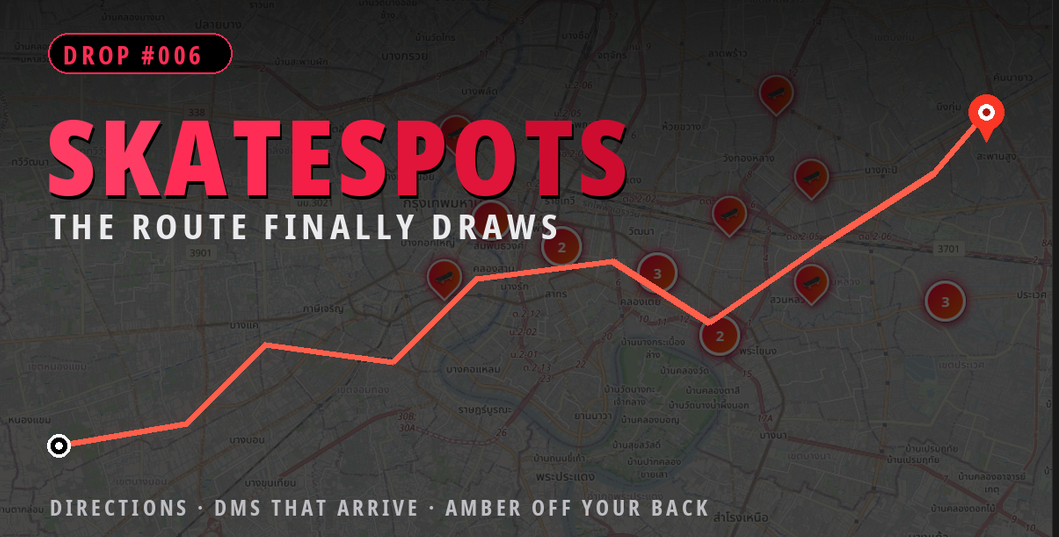
- NEWSLETTER_ISSUES now leads with #006 (2026-09-27): the Nostr-Twitter-Clone
  rant, the Directions fixes (route never drew + identical per-mode numbers),
  follow mode, choose-your-start + offline saved routes, Sasquatch Pro
  (sats-paid, streamed, personal tools, one signature per session), the
  Marketplace hub + 1-10 deck ratings, Mints (directory + the native JSON-error
  fix), Amber scoping, the DM inbox-relay bug, and the polish list.
- Cover: https://skate-spots.org/images/drop-006-cover.png (hosted in
  public/images, added in e075ee8).

Verified: the archive renders the cover + #006 copy, and the 'Drop #006 is out'
pill shows on other pages for 7 days. tsc/eslint clean, 101 tests, smoke PASS.
Follow mode (explicit Start; off by default — a watcher drains battery):
watchPosition in geolocation.ts, live dot, 'NEXT · step N' banner with
distance-to-turn + distance-to-go, current step highlighted, map follows.
A transient watch error (timeout/unavailable) no longer kills it — only a
permission denial does; the watcher recovers on its own.

Choose your start: 'From → My location / Choose on map' — tapping the map sets
the origin, and the route recomputes from there.

Offline: src/lib/routeCache.ts keeps the last route per destination+mode with
the line downsampled to <=250 points. If a fetch fails (no signal / routing
server down) the dialog falls back to it with an 'Offline · saved route {age}'
badge instead of a dead error.

Also tidied the map overlays (offline badge bottom-left, Whole route
bottom-right) so nothing covers Leaflet's zoom control.

Verified with CDP: controls present; follow banner tracks movement (step 1 ->
step 7, distances update); blocking routing shows the cached route + badge;
picking a start on the map changed the route (968 m -> 922 m). Still no voice
guidance or re-routing if you leave the route (documented).
AMBER — 'pops on every screen':
staleTime: Infinity only stops REFETCHING, never the FIRST decrypt. So the
encrypted useSyncedAppData blobs (read-state, preferences) each ran a queryFn on
mount (racing consumers multiplied it) and relay responses landing during
navigation made it look per-page. useSyncedAppData now has interactiveNetwork
(default false): for an interactive signer the blob is LOCAL-ONLY — query not
even enabled, patch() a no-op — no decrypt on mount, no publish on a nav-tab
change. Verified with a mocked x-amber login: network-on => Amber op at startup,
with the fix => 0. (useCrewDismissals/useStash were already gated.)

ROUTING — 'same time for every transport option':
router.project-osrm.org hosts ONE car dataset and ignores the profile in the URL,
so foot/bike/car returned identical numbers. Switched to the FOSSGIS per-profile
servers (routing.openstreetmap.de/routed-{foot,bike,car}); the demo server is now
only a last-resort fallback and its result is flagged approximate ('driving
estimate'). Request steps=true and surface turn-by-turn steps for orientation,
plus a '~X min on a board' skate estimate next to the walking time. Verified:
same trip => walk 13 min / bike 5 / moto+car 2, with 5-9 steps each.
RouteDialog was effectively broken — users got an empty dialog / 'no route'.

- Map init: the Leaflet map lives in Radix Dialog content, which mounts AFTER
  the first effect pass, so the mapDivRef guard was null, the init effect bailed,
  and the map was never created (no route line, ever). Hold the node in state
  with a callback ref and add it to the effect deps.
- Height: the global .leaflet-container{height:100%} override beats h-64; against
  a height-less parent it resolved to 0 (invisible map). Height now lives on the
  wrapper (relative h-64) and the map is h-full.
- Stacking: from the map, Directions rendered the dialog inside the spot Sheet
  (two nested Radix modals; the sheet covered the route). The map now owns the
  RouteDialog at page level and closes the sheet first.
- Routing transport: call OSRM directly (it sends CORS '*') with the cors proxy
  only as fallback; distinguish busy / no-route / unreachable errors and guard
  against NaN coordinates.
- Nav: MIDDLE_SLOTS 3->4 and add 'mints' to the default middle + desktop tabs,
  so the Cashu mints directory is reachable on the phone out of the box (also
  still linked from Wallet; any of the 4 slots can be swapped via long-press).
- Directions: RouteDialog now seeds the origin from the last known location and
  draws immediately, then refines with a live fix — no more hanging on 'Finding
  your location…'. Shortened the web geolocation fallback 15s -> 8s.
- Amber: /api/ai/status is now public (it only reports a small balance), so
  showing the AI balance no longer signs NIP-98 / opens the signer. The signer is
  reserved for actions that actually need it.
- sasquatchBrain: PROXY_MODELS now match the Routstr node's slugs
  (gemini-3-6-flash, z-ai-glm-5-3, gemini-3-7-flash).
- ai.mjs: new owner-only POST /api/ai/status (NIP-98 + owner pubkey) returning the
  upstream balance + a 'low' flag (<500 sats); config.path now serves both routes.
- useSasquatchAiStatus + SasquatchAiStatusCard (owner-only, in Settings): shows the
  balance and warns when low — the top-up nudge, no webhook/notification key needed.
- netlify/functions/ai.mjs: optional Pro enforcement (SASQUATCH_REQUIRE_PRO=1).
  Requires a NIP-98 kind-27235 auth header (x-sasquatch-auth) and, unless the
  caller is a platform owner, an active Pro pass (x-sasquatch-pro = a
  provider-authored zap receipt) verified OFFLINE — signature, user binding,
  platform tag, and paid-amount → tier. Off by default.
- src/lib/proAuth.ts: signs the NIP-98 once per session (no Amber popup per
  message) and attaches the Pro receipt.
- sasquatchBrain: threads auth headers through the proxy (streaming + non).
- useSasquatchPro: exposes the winning receipt event.
- Verified: 200 with the gate off, 401 with it on (env reset afterwards).
The pay-to address was duplicated (PRO_LIGHTNING_ADDRESS and
PLATFORM_LIGHTNING_ADDRESS) and hardcoded in the tour zap-split; a typo in any
copy would send money nowhere. Now one source of truth in src/lib/platform.ts,
re-exported by the fee/Pro modules.

Also surface the address in the Sasquatch Pro dialog ('Pays to ⚡ <address>') so
users can see where their sats go, in both the auto-pay and manual-QR paths.
- netlify/functions/ai.mjs: POST /api/ai runs against Netlify's AI Gateway —
  Netlify injects OPENROUTER_API_KEY + OPENROUTER_BASE_URL into Functions, so no
  key is managed or shipped. Curated model allowlist, best-effort per-IP
  throttle, CORS for web + Capacitor, and SSE streamed straight through.
- sasquatchBrain: call the proxy instead of OpenRouter directly; drop
  VITE_OPENROUTER_API_KEY entirely; PROXY_MODELS set to the slugs that actually
  work via the gateway (its ZDR policy blocks gemini/anthropic/gpt-4o-mini).
- netlify.toml: [functions] directory.
- Verified in production: POST https://skate-spots.org/api/ai -> 200.
- MapPage: replace the external 'Open with' menu (Google/OSM/Waze) with the
  shared in-app RouteDialog, so the map spot sheet routes natively (incl. the
  Transitous transit mode).
- FoodPage: replace the Google Maps handoff with RouteDialog.
- RouteDialog: remove the opt-in external 'Open in' handoff and delete
  src/lib/directions.ts — no external map apps anywhere (product decision).
- sasquatchBrain: new streamSasquatchAI — OpenAI-style SSE via OpenRouter (if
  the key is set) then Pollinations; falls back to the non-streaming caller only
  when nothing at all was delivered, so blocked-stream environments still answer.
- SasquatchGuide: stream the first pass into a live bubble (raw JSON tool calls
  are suppressed so partial JSON never shows; prose-then-tool output is dropped),
  finalise the bubble in place, show a blinking cursor, and hide the generic
  'thinking...' bubble while a reply streams.
- Drop Pollinations 'mistral' (now a 404) leaving the live 'openai' slug.
- routing.ts: add a 'transit' travel mode via Transitous (MOTIS 2 API, keyless,
  open CORS), with a local precision-7 polyline decoder and per-leg parsing.
  Road modes stay on keyless OSRM; moto remains ≈car and honestly labelled.
- RouteDialog: transit draws each leg (walk dashed grey, transit coloured by
  mode) and summarises depart→arrive, duration, transfers and line chips, with
  Transitous/OpenStreetMap attribution.
- directions.ts: opt-in 'Open in' handoff to Google / Apple / OpenStreetMap
  (+ Organic Maps via geo: on Android), mode-aware. In-app routing stays the
  default; the description notes transit shares the trip with Transitous.
- No scooter/moped profile (deliberate).
- sasquatchBrain: abort each provider request after 15s and give up the whole
  multi-provider attempt after 35s, so a hung OpenRouter/Pollinations call can no
  longer wedge the chat (it now falls through to the static/local fallbacks).
- SasquatchGuide: send the system prompt as a real system message (both the
  first pass and the tool-synthesis pass) instead of smuggling it into a user
  turn, and mark tool output as untrusted — blunts prompt injection via event
  content.
- useCVMClient: signature-verify (verifyEvent) every relay result, matching the
  standalone server and the release-notes claim.
- useCVMServerHealth: stale threshold 1h -> 45m to match the server heartbeat.
- Lab forms: a non-empty email must be valid and website/portfolio must
  resolve to an https URL; invalid input shows an inline hint and blocks
  publish. Adds isValidEmail() (reused by sanitizeEmail). social/instagram
  are exempt since they may be bare @handles.
- New PhotoDropzone component: drag & drop plus multi-select image input,
  emitting File[] to the caller. Wired into CreateSpotPage + EditSpotPage
  (drop several photos at once) and AddPhotoToSpot, replacing the old
  one-file-at-a-time inputs.
- Spot photo uploads run sequentially and dedupe URLs.
- Preserve the geo 'g' tag and paid 'featured' tag when editing any Lab
  profile (all 7 craft roles via CraftProfileForm + 5 bespoke pages).
- Render previously collected-but-hidden fields on the Lab profile page:
  judge 'events_judged', organizer 'events_hosted', editor hardware/software,
  and spot references.
- Include Event Organizer (35013) in Community Stats + counts.
- Cap Title inputs at 100 (was 120) so profiles no longer fail the parser
  and silently vanish; MIN_TITLE_LEN 2 -> 1 for 1-char display names.
- Normalize bare-domain URLs (example.com) to https:// before storing instead
  of dropping/hiding them (new normalizeUrlInput helper; fixes extra url fields).
- No crew strip for judging/organizing (was wrongly showing Photo & Film);
  scrollable Offer Services FAB; live bio counters.
Add a purposeful subset of Amethyst-style relay categories (not a full clone):
- App-local 'Local relays' (never published; added to reads+writes)
- App-local 'Blocked relays' (excluded from every read/write)
- src/lib/relays.ts: resolveRelays()/useRelays() + URL normalisation
- NostrProvider req/event routers go through resolveRelays (blocklist applied)
- RelayListManager: Local/Blocked editors; NIP-65 save now preserves the new
  lists instead of overwriting relayMetadata

Deliberately omitted (documented in AGENTS.md): KeyPackage (10051, no MLS
consumer) and proxy/broadcast/private-home (no such discovery model here).
Follow-up noted: a few hooks still read config.relayMetadata.relays directly.
Real, oracle-free escrow built on Cashu P2PK with a locktime + refund key:
buyer locks funds to the seller; seller redeems on delivery; the buyer can
reclaim after the deadline. Locked (not plain) tokens are what make the
cashu_token on a public 31872 safe.

- src/lib/cashuEscrow.ts: pubkey normalisation (x-only -> compressed), P2PK
  policy builder, offline token inspection (amount/mint/locktime/refund), and
  an injectable createEscrowToken mint flow (quote -> pay -> mintProofs{p2pk})
- 15 unit tests incl. the mint orchestration against a fake wallet
- Protocol: advertise a 'cashu_escrow' pubkey in kind 0 (NIP.md); token rides
  the existing 31872 cashu_token tag
- ESCROW.md: design, threat model, status, limitations
- AGENTS.md: project map + docs index updated

Wallet UI (cashu-ts + payment rail + profile publish) is native-only and still
needs on-device verification.
Symptom: in the long-running dev server some lazy routes (/settings, /stash,
/collections, /stats) hit the route error boundary ('This page slammed') while
others worked. Console: 'Failed to fetch dynamically imported module'; network:
504 for node_modules/.vite/deps/*.js. Vite's dep-optimizer cache had gone
missing after the server re-optimized on a lockfile change, leaving stale ?v=
hashes.

- Add lazyWithRetry: on a chunk-load failure, retry once, then do a single
  full reload per session (avoids reload loops); clears the flag on success
- Use it for all 53 lazy routes in AppRouter
- Document the dev dep-cache gotcha + fix in AGENTS.md
Data-driven pass (adds rollup-plugin-visualizer behind ANALYZE=1):
- MapPage was statically imported by the router, dragging the map route AND the
  IndexedDB offline-cache layer into the entry -> now lazy()
- NewsletterOverlay imported NEWSLETTER_ISSUES from the whole NewsletterPage
  module -> types + data moved to lib/newsletterIssues.ts
- SasquatchGuide (assistant overlay) lazy-loaded in Layout
- Cashu stack is now a separate chunk (useCashu), off the critical path

Net: entry down ~61%; first paint no longer parses the map, the newsletter
page, the assistant or the wallet stack.
- geolocation: cap the overall deadline at 15s (was 25s) and shorten the native
  plugin attempt to 8s, so a failed fix no longer hangs ~25-40s
- MapPage: only warm the location cache when permission is ALREADY granted, so
  opening /map no longer fires the browser's 'Allow location?' prompt
- MapPage: add a desktop Near Me control (it was mobile-only)
- MapPage: on native, a denial is now retryable instead of permanently opening
  the browser-only help sheet
The bolt11 amount decoder is correct — the three failing tests used the
wrong invoice fixture. Per BOLT11, `lnbc2100n` = 2100 x 1e-9 BTC x 1e8
sats = 210 sats, not 21. A 21-sat invoice is `lnbc210n`. The passing
`lnbc1000n = 100 sats` case confirms the decoder's math.

Corrected the three cases in bolt11.test.ts and verifyInvoice.test.ts
to use `lnbc210n` (21 sats) so they exercise the intended 21-sat / 1-sat
slack scenarios against the correct implementation.

Co-authored-by: shakespeare.diy <assistant@shakespeare.diy>
- Replace single-assignment `let timer` with a `timers[]` array in
  citrine.ts and relayProbe.ts so stricter prefer-const builds pass
  (the newer ESLint pulled in by `npm audit fix` flagged the let as
  never-reassigned).
- Drop two now-redundant `eslint-disable react-hooks/exhaustive-deps`
  directives in NostrProvider and MapPage. Newer react-hooks no longer
  reports those lines, so the directives were flagged as unused errors
  under reportUnusedDisableDirectives; removing them is safe in both
  old (warning only) and new (silent) ESLint.

Co-authored-by: shakespeare.diy <assistant@shakespeare.diy>
Two type errors (surfaced by `npm run test` / tsc --noEmit on a full
toolchain; the in-browser bundler does not run tsc, so they were latent):

- useCVMClient.ts: remove a malformed cast
  `spots as typeof spots & { tags; created_at }[]` feeding
  deduplicateByIdentity(). The intersection dropped pubkey/kind and broke
  the reassignment to `spots`. deduplicateAddressable() already returns
  the correct shape, so the cast was both wrong and unnecessary.

- queryPersister.ts: import PersistedClient / Persister from
  @tanstack/query-persist-client-core (their canonical source) instead of
  @tanstack/react-query-persist-client, whose `export *` re-export tsc
  won't resolve for named type imports. Added the core package (5.102.8,
  matching the pinned wrapper) as an explicit dependency.

Both are pre-existing issues on the branch, unrelated to the audit
remediation commits.

Co-authored-by: shakespeare.diy <assistant@shakespeare.diy>
Cover the three highest-value pure functions in the security/payments
path — previously untested:

- bolt11.getSatoshisFromBolt11: m/u/n/p multiplier decoding, amountless
  invoices, 21-sat zap case, case-insensitivity, testnet/regtest
  prefixes, and malformed-input throwing.
- verifyInvoice.assertInvoiceAmount: accepts matching amounts + 1-sat
  rounding slack; rejects the core attack (over-charging invoice),
  amountless-when-expected, malformed, and empty input.
- sanitizeUrl + companions: https passthrough, http→https upgrade,
  javascript:/data:/file: rejection, relative-path rejection, plus
  sanitizeCssString / urlDomain / sanitizeTel / sanitizeEmail.

Note: run `npm run test` on a full toolchain to execute these — the
in-browser builder bundles but does not run vitest.

Co-authored-by: shakespeare.diy <assistant@shakespeare.diy>
Closes two items from the platform/completeness audit appendices.

Amber signature verification (audit "open verification item", LOW):
reconstructSignedEvent() previously trusted whatever `sig` the external
Amber signer app returned — it recomputed the event id but never
verified the Schnorr signature. A compromised or buggy signer could
therefore return a forged/garbage signature that the app would treat as
valid and publish. Now verifyEvent() is run on the reconstructed event
before it is returned; failures return null, which every caller already
handles as an "incomplete signature" error. This single choke point
covers all Amber paths: the native AmberIntent signer, AmberCallbackPage,
and AmberCallbackHandler.

F9 (LOW): pin MCP server versions in .mcp.json. Both js-dev-mcp and
nostrbook/mcp were fetched at @latest, silently pulling the newest
release into the agent tool environment every session. Pinned to the
current exact versions (0.6.3 / 0.5.3) so upgrades are deliberate.

Co-authored-by: shakespeare.diy <assistant@shakespeare.diy>
Empty states (P4 follow-up):
- CrewsPage and EventsPage now render the shared <EmptyState> instead of
  their own local copies, keeping spacing/actions/footer consistent.

Become-role routes (P1):
- Add src/lib/becomeRoles.tsx: single registry mapping each role slug to
  either a CraftProfileForm config (artist/graffiti/musician/judge/tattoo/
  trainer) or a lazy bespoke page (coach/filmer/editor/photographer/
  builder/skater). The 6 craft roles were already thin config wrappers, so
  their configs move into the registry and the wrapper files are deleted.
- Replace 12 hardcoded /become-* routes + 12 imports with one
  /become/:role route (BecomeRolePage) that renders from the registry.
- Legacy /become-<slug> URLs now redirect to /become/<slug> so shared/
  bookmarked links keep working.
- Update all internal links (LabPage, Index, SkatersPage, SpotDetailPage,
  NIP19Page, SkaterDirectoryCard) to the canonical /become/<slug> paths.

Note: the 5 large bespoke forms were intentionally NOT merged into one
config — they carry distinct machinery (SpotPicker, wallet/Pro, geohashing)
and forcing them together would increase complexity, not reduce it.

Co-authored-by: shakespeare.diy <assistant@shakespeare.diy>
Skaters need to know if a spot is roofed/indoor so weather info isn't
misleading — a covered or indoor spot is still skateable in the rain. Added a
4-way shelter level: outdoor (default) / partial / covered / indoor.

Data model (types.ts + skateTags.ts):
- SkateSpot.shelter parsed from a `['shelter', value]` tag (validated to known
  values; absent/unknown → treated as outdoor).
- shelterOptions / DEFAULT_SHELTER / SHELTERED_VALUES + ShelterType exported.
- SHELTER_INFO display map (emoji/label/short/color) for badges.

Publishing (CreateSpotPage + EditSpotPage):
- New "Shelter" selector reusing the exact selectable-Card pattern used by
  Access Type / Spot Type (cn() borders, neon ring, corner check badge).
- Emits `['shelter', value]` always, plus a queryable `['t', value]` for
  sheltered spots (indoor/covered/partial) so "dry spots" filtering + Sasquatch
  search work at the relay level. Outdoor adds no t tag.
- EditSpotPage initialises from the existing spot and preserves the value.

Display:
- Shelter badge on SpotDetailPage, SpotCard, and the MapPage popup — only shown
  for sheltered spots (outdoor stays unbadged to avoid clutter).

Docs:
- NIP.md: shelter added to the optional-tags table, a dedicated Shelter section
  explaining values + the queryable-t-tag behaviour, and an indoor example.

Build clean, no console errors.

Co-authored-by: shakespeare.diy <assistant@shakespeare.diy>
Three low-risk speedups focused on the slowest path — questions that hit live
relay data:

1. Relay timeout 10s → 4.5s (6s for the fan-out community stats). The useful
   relays answer in ~2s; the old 10s just let one slow/dead relay stall the
   whole reply.

2. Results-first: for finder tools (spots/events/coaches/gear/crews/shops/
   tours/stats/weather) format the CVM result locally and SKIP the second
   "prettify" AI call. Removes a full model round-trip (~2–4s) — users want the
   list, not extra prose. New toolCallToIntent() maps a tool call to the existing
   formatLocalResults() path. Personal/Pro tools (get_my_*) still use AI synthesis.

3. Faster AI fallback: cap OpenRouter attempts to the top 3 free models before
   the keyless backup, and shorten 429 backoff (≤800ms vs ≤2500ms). Avoids the
   worst-case 15–20s grind through 8 models on a busy free tier.

Conversational/knowledge answers (single AI call) keep Sasquatch's personality
and are untouched.

Co-authored-by: shakespeare.diy <assistant@shakespeare.diy>
Countdown badges (upcoming tours):
- New getCountdown() in TourCard: "In 3 days" / "Tomorrow" / "In 2 weeks" /
  "Happening now" (pulsing) based on start/end dates, category-tinted
- Shown on both compact and full TourCard, and in the TourDetailPage schedule card

NIP-05 provider fix (removes obsolete nip05.social):
- New single source of truth src/lib/nip05Providers.ts with working, curated
  providers: nostrcheck.me + nostr.directory (free), Nostr Plebs + nostr.band (paid)
- New reusable Nip05Required component (full-page "gate" + inline "banner"
  variants) listing those providers and deep-linking to /settings?section=nip05
- Wired into CreateTourPage (gate), CreateListingPage (banner) and all four
  Become* pages (Coach/Filmer/Photographer/Builder) for a consistent prompt
- SettingsPage NIP-05 screen now reads from the shared provider list
- Updated internal planning docs to match

Co-authored-by: shakespeare.diy <assistant@shakespeare.diy>
- Add a unified Schedule section across all four tour categories:
  - Local: choose a fixed session (date+time) or flexible/by-appointment
  - National/International: required departure + optional return trip dates
  - Destruction: existing competition window, now with end>=start validation
- Reuse start-date/end-date tags for every category (parser already supported them)
- Fix datetime handling: dedicated toDateInput/inputToSecs helpers so date and
  datetime-local inputs round-trip correctly (previous mix of toLocalInput +
  type="date" was inconsistent)
- Consistent, logical mandatory-field validation with clear required markers
- Redesign the header into an immersive, category-tinted, grunge-striped banner
  and rebuild the category selector as elegant glowing cards
- New calendar utilities (.ics + Google Calendar) and AddToCalendar component
- TourDetailPage is now fully category-aware (badge, guide label, duration,
  SEO title) with a Schedule card + Add to Calendar for attendees
- TourCard shows the schedule for all categories (time for local sessions)
- Update NIP.md to document start-date/end-date across categories

Co-authored-by: shakespeare.diy <assistant@shakespeare.diy>
Three UX wins so the app feels "already loaded" the moment it opens:

1. IndexedDB React Query persistence (lib/queryPersister.ts)
   - PersistQueryClientProvider rehydrates the last-seen spots, shops,
     events, tours, crews, coaches, listings and author profiles from
     IndexedDB on cold start, so returning users land on a populated map
     instead of a blank one; fresh data refetches quietly in the
     background.
   - Strict allow-list / deny-list: only public, JSON-serializable,
     cold-start-relevant queries are persisted. Private/encrypted data
     (stash, DMs, contacts, wallet/nwc/cashu/bitcoin, signer) is NEVER
     written to disk. 24h maxAge + version buster keep it fresh & safe.
   - Pinned @tanstack/react-query + query-core + persist-client to a
     single 5.102.8 to avoid a query-core mismatch (partialMatchKey).

2. Optimistic geolocation (lib/lastLocation.ts)
   - getCurrentPosition now caches every successful fix.
   - The map opens ALREADY centered on the user's last-known area
     (city zoom) instead of the world view; "you are here" + proximity
     sort seed from the cache instantly.
   - "Near Me" flies to the cached location immediately on tap, then
     refines to the fresh GPS fix. Silent background warm-up on web map
     mount so a later tap resolves instantly.

3. Cold-start skeleton (components/MapSkeletonPins.tsx)
   - When the map is genuinely empty + loading, show elegant pulsing
     ghost pins + a "Finding spots" pill instead of a blank map; they
     vanish the instant real (or cached) spots render. Splash now
     signals content-ready when spots actually resolve.

Respects prefers-reduced-motion throughout. Build + runtime verified
clean (no console errors).

Co-authored-by: shakespeare.diy <assistant@shakespeare.diy>
Security & reliability audit follow-up. The app was already well-hardened
(strict CSP synced across index.html/_headers/netlify.toml, careful
textContent/escapeHtml in the Leaflet DOM, broad sanitizeUrl usage,
consistent author-filtering on trust-sensitive queries). This closes the
remaining gaps:

- sanitizeUrl is now HTTPS-only: bare http:// links are upgraded to
  https:// (not silently dropped); every other scheme (javascript:,
  data:, file:, relative) is rejected. Removes a downgrade/mixed-content/
  IP-leak vector and matches the native HTTPS-only WebView. Added a
  sanitizeCssString() allowlist helper for future CSS interpolation.

- Route-level ErrorBoundary (RouteErrorBoundary) wraps the routed pages,
  keyed by pathname: a crash in one page now shows a recoverable
  "this page slammed → go back" message while the header/nav/rest of the
  app keep working, instead of the single top-level boundary blanking the
  ENTIRE app. Resets automatically on navigation.

- ErrorBoundary fallback no longer leaks stack traces to users (full
  detail still logged to console for us); redesigned on-brand ("Slammed",
  neon, reassures that account + data are safe). Updated its test.

Author-filtering spot-check across admin/newsletter/featured/crew/stash
paths found no gaps — all trust-sensitive queries correctly constrain
authors.

Co-authored-by: shakespeare.diy <assistant@shakespeare.diy>
Full self-audit of the Citrine feature. Fixes found:

Robustness
- Probe now tries BOTH ws://127.0.0.1 and ws://localhost and routes to whichever
  actually answers (probeCitrineEndpoints + CitrineProbeResult.url). We no longer
  bet the whole feature on one loopback address form; useCitrine.url reflects the
  winning endpoint so reads/writes go to the right place.

Correctness
- Preview toggle was mutating the REAL setting while in dev-preview; handleToggle
  is now a no-op under preview (forced state owns the visuals).

Accessibility / "flawless" bar
- Respect prefers-reduced-motion: status pips, chip pop-in and the expand slide
  now motion-reduce:animate-none (no looping glow/pulse for reduced-motion users).
- Recheck button gets an aria-label; status text is role="status" aria-live so
  screen readers announce searching→detected transitions; decorative pips are
  aria-hidden.

UX copy
- "Waiting" state no longer presumes Citrine isn't installed. Clearer two-step
  guidance (Open Citrine → Start; come back → Recheck) covering the common
  "installed but not started/detected yet" case.

Honest note: MIXED_CONTENT_ALWAYS_ALLOW (1.3.5) is the high-probability fix for
the 0-connections block but is not device-verified from here; the dual-endpoint
probe hedges the second most likely cause (address form).

Co-authored-by: shakespeare.diy <assistant@shakespeare.diy>
Citrine is running (listening on ws://127.0.0.1:4869) but the app can't connect
and shows 0 connections — a WebView-layer block, not our logic. To diagnose
without adb/USB, the probe now returns { ok, reason } capturing which stage
failed (blocked / connect-error / timeout-no-open / opened-but-no-nostr-reply /
closed-before-open with code), and the Settings card shows a small debug readout
(probe url + reason) whenever not connected. Purely additive; no behaviour
change to routing.

Co-authored-by: shakespeare.diy <assistant@shakespeare.diy>
Self-audit of the 1.3.0–1.3.2 Citrine feature found two real issues:

1. False-positive detection (the important one). probeCitrine resolved true on
   bare socket OPEN, so ANY process squatting on 127.0.0.1:4869 would be treated
   as Citrine — and we'd then route reads AND published events at a non-Nostr
   peer. The probe now completes a minimal Nostr handshake: open → send a bounded
   REQ with a random sub id → require a protocol-shaped reply (EVENT/EOSE/CLOSED
   echoing the sub id, or a NOTICE) before declaring the relay live. Non-JSON /
   non-Nostr responses fall through to a clean timeout=false. A real relay
   answers with EOSE in ~ms on localhost, so the happy path is unchanged.

2. Probe churn. The reachability query re-opened a fresh ws:// probe every 5 min
   and on every window focus for the whole session — needless battery/wakelock,
   and a localhost poke on every Amber round-trip. Now it only polls (30s) and
   refetches-on-focus WHILE still waiting for Citrine to appear; once connected
   it stops the background churn (a per-session local relay won't vanish
   silently, and a failed read re-probes naturally).

Reviewed and left as-is (deliberate, safe): writing every kind to Citrine incl.
gift-wrapped DMs / Stash is intended on-device encrypted backup — all sensitive
kinds are NIP-44 encrypted before reaching the publish layer, so nothing
plaintext-sensitive is mirrored. Preview flag remains render-only.

Co-authored-by: shakespeare.diy <assistant@shakespeare.diy>
The CitrineCard is Android-only (renders null off-native), so its four visual
states couldn't be reviewed without an APK build. Adds a strictly cosmetic
preview switch:

  localStorage.setItem('citrine:preview', '1')         // show card, real behaviour
  localStorage.setItem('citrine:preview', 'live')      // force connected state
  localStorage.setItem('citrine:preview', 'waiting')   // force not-detected
  localStorage.setItem('citrine:preview', 'searching') // force searching
  localStorage.removeItem('citrine:preview')           // back to normal

Safety: the flag unlocks RENDERING ONLY via isCitrinePossible(). It never sets
citrine.active and never yields a relay url, so no query or publish is ever
routed anywhere different — production relay behaviour is identical with or
without the flag. A forced state is purely visual (enabled/probing are derived
locally in the card for preview; the real probe still governs active/url).

lib/citrine.ts: citrinePreview()/isCitrinePreview() + CitrinePreviewState.
useCitrine: exposes `preview`. CitrineCard: forced state overrides the computed
state for review only.

Co-authored-by: shakespeare.diy <assistant@shakespeare.diy>
Integrates Citrine (github.com/greenart7c3/Citrine), an Android app that runs a
full Nostr relay locally on the phone. Because it's "just a relay URL", it folds
into the existing useSkateRelays / nostr.relay() machinery with no new protocol.

What it buys SkateSpots:
- Instant reads: a localhost hit (~1ms) is queried first, remote relays run in
  parallel and reconcile — every skate-content surface feels faster.
- Offline-in-the-field: reads work with no signal; writes land on-device and
  publish to remote when connectivity returns.
- Resilience/backup: a durable local copy of the user's own events survives
  public-relay outages and addressable-event eviction.
- Privacy: local-first data can lean on the device instead of public relays.

Design / safety:
- Android-only (Capacitor native + platform === 'android'); renders nothing and
  never probes localhost on iOS/desktop web. Mixed-content ws:// is already
  permitted via capacitor allowMixedContent.
- Opt-in only via config.useCitrineRelay (default off). No data is ever routed
  through Citrine unless the user enables it AND a relay is actually reachable.
- Reachability probe (short-lived WebSocket) cached through react-query, shared
  app-wide, re-checked periodically + on focus, with a manual Recheck button.
- When active, the local URL is prepended to reads and included in writes; the
  read-relay set feeds getQueryKeySuffix so caches refetch automatically when
  Citrine comes/goes.
- Encryption unchanged: Stash/DMs stay NIP-44 encrypted regardless of
  destination — the Settings card states this explicitly. Local ≠ plaintext.

New: src/lib/citrine.ts, src/hooks/useCitrine.ts, CitrineCard in the Relays
settings screen. AppConfig gains useCitrineRelay (zod-validated, optional).

On-device verification still needed: confirm Android permits ws://127.0.0.1
cleartext to localhost (network security config) once Citrine is running.

Co-authored-by: shakespeare.diy <assistant@shakespeare.diy>
With Amber as signer, every nip44 decrypt is a foreground intent (visible
popup). Several hooks decrypt inside auto-running queries, so Amber flashed on
navigation/focus and (worst case) storms — one popup per encrypted event, and
polling queries re-fired every few seconds.

New helper isInteractiveSigner() (signerCapabilities.ts) detects the Amber
(x-amber) signer, where each crypto op prompts the user. Hooks now gate passive
decryption for interactive signers only; extension/nsec/bunker keep their
silent, live-polling behaviour.

Fixes:
- useCrewDismissals (GLOBAL via header NotificationBell — the main offender):
  Amber users now use the instant localStorage mirror only, never passively
  decrypt the synced list; disabled refetchOnWindowFocus + Infinity staleTime.
  Dismissals still sync OUT on the write path.
- useDirectMessages (all 4 DM query hooks): added amberSafeQueryOptions() —
  no background polling and no focus refetch for Amber (these decrypt up to
  ~200 gift wraps × 2 each); silent signers keep the 60s poll.
- useStash / usePrivateContacts: disabled focus refetch + Infinity staleTime
  for Amber so the single decrypt runs once, not on every focus.
- useCordnChat: dropped the 5s live poll for Amber (was a popup every 5s);
  silent signers keep it.

Scanned every signEvent call site: all are inside mutations/user callbacks
(zaps, invites, DMs, chat, follows, purchases, NIP-98 auth) — no passive
auto-signing anywhere. Deliberate user actions still prompt Amber as intended.

Co-authored-by: shakespeare.diy <assistant@shakespeare.diy>
Root cause: the stock nostr-signer-capacitor-plugin (0.0.5) tries Amber's
background ContentProvider first, which GrapheneOS blocks and never returns,
with no clean fallback — so signing hung 90s and Amber never appeared.

Fix (matches Amethyst, the reference NIP-55 client):
- New native Capacitor plugin AmberIntent (android-templates/AmberIntentPlugin.java)
  that goes STRAIGHT to a foreground nostrsigner: intent via a properly-registered
  ActivityResultLauncher, tracks each request by id, and times out gracefully.
- MainActivity now registers the launcher in onCreate (AndroidX contract) and
  hands it to the plugin, while staying a safe stock BridgeActivity (no
  WebViewClient override → no black screen).
- inject-main-activity.mjs now installs both MainActivity.java and AmberIntentPlugin.java.
- capacitorAmberSigner.ts rewired to registerPlugin('AmberIntent'); every op is a
  user-visible Amber Approve/Reject popup; rejections surface as a friendly message.
- Removed the dead npm nostr-signer-capacitor-plugin dependency (and its phantom
  coracle fork spec) plus its vite external entry — signing no longer uses it.
- Delete flow copy updated to the new foreground UX (Approve in Amber / Cancelled
  on reject) instead of the diagnostic SIGN/PUBLISH narration.

Co-authored-by: shakespeare.diy <assistant@shakespeare.diy>
Fixes the audit findings:

HIGH-1 (NWC/WebLN auto-pay of unverified invoices): add assertInvoiceAmount and
call it before every programmatic payment in useZaps, useCrewZap, and
SpamFeePayment. A malicious LNURL/Lightning-address server can no longer return
an inflated invoice and drain the wallet — amount is decoded from bolt11 and must
match the intended sats (±1 sat), amountless invoices are rejected.

HIGH-2 (forgeable trust signals):
- useSasquatchPro: Pro is granted ONLY by a zap receipt AUTHORED by the
  platform's Lightning provider, embedding a user-signed zap request that tags
  the platform, with a real paid amount >= smallest tier. The self-signed
  kind:32671 receipt is now advisory only and never grants access (closed the
  "self-grant permanent Pro" hole).
- useFeaturedVerification: a listing is 'verified' only when the matching 9735 is
  authored by the provider pubkey (not any self-published receipt).
- useCrewGoal: tally only invoice-backed (bolt11) zaps; the forgeable amount tag
  is no longer summed, so goal progress can't be inflated with fake receipts.

Bump to 1.2.14.

Co-authored-by: shakespeare.diy <assistant@shakespeare.diy>
Verified against the plugin's Java source: signEvent/nip*Encrypt/Decrypt
IMMEDIATELY reject with "Signer package name not set" when no package is
configured — which is exactly what my earlier "omit packageName" change caused,
and that rejection surfaced as the endless spinner on delete/accept/zap.

With the package set, the plugin tries the content resolver, and when that
returns null (permission not remembered) it falls back to
startActivityForResult(nostrsigner:) — the SAME native call login uses that
reliably opens Amber. Restore native plugin signEvent/nip04/nip44 with
setPackageName + AMBER_PACKAGE, reconstruct signature-only responses, and remove
the unused JS-intent bridge. Bump to 1.2.9.

Co-authored-by: shakespeare.diy <assistant@shakespeare.diy>
Amber never appeared for delete/accept-invite/zap because Capacitor's default
WebView silently drops JS-initiated intent:/nostrsigner: navigations — the
request that opens Amber never reached the OS. Login worked only because it
uses the plugin's native startActivityForResult.

Add a custom MainActivity (android-templates/MainActivity.java) that overrides
shouldOverrideUrlLoading to launch intent:/nostrsigner: URLs via startActivity()
— a real native launch that opens Amber on GrapheneOS, matching login. Injected
into the generated android/ project at build time by inject-main-activity.mjs,
wired into android:build/sync/init. Simplify the JS launcher to navigate the
WebView (now intercepted natively). Bump to 1.2.8.

Co-authored-by: shakespeare.diy <assistant@shakespeare.diy>
The capacitor plugin's signEvent/encrypt query Amber's ContentProvider first,
which stalls on GrapheneOS and never launches Amber's approval UI — causing
delete, accept-invite, zaps, and every signing action to hang forever.

Add amberIntentBridge.ts which drives Amber through the reliable
intent:...scheme=nostrsigner flow (the same path login uses that actually opens
Amber), returning a promise resolved in-process via the org.skatespots.app://
deep-link callback (DeepLinkHandler → resolveAmberIntent). CapacitorAmberSigner
now routes signEvent/nip04/nip44 through this bridge instead of the stalling
ContentResolver path. Fast 60s fail-safe with a clear message instead of an
indefinite spinner.

Co-authored-by: shakespeare.diy <assistant@shakespeare.diy>
The likely real cause of "Amber never pops up, delete hangs" on
GrapheneOS: login only requested the get_public_key permission, so later
sign_event / encrypt / decrypt calls hit a per-action permission check
that routes through Amber's ContentProvider and stalls WITHOUT showing a
prompt. Now login pre-grants get_public_key, sign_event, nip04/nip44
encrypt+decrypt up front, so subsequent signing is a fast background
round-trip with no surprise permission stall.

IMPORTANT: existing sessions only granted get_public_key — users must log
out and back in once for Amber to grant the new permission set.

Co-authored-by: shakespeare.diy <assistant@shakespeare.diy>